
SMU & Co.
- pressymax25
- Jun 15, 2025
- 7 min read

Updated: Jun 18, 2025
Written by Wu Niutian and Ng Cheng Jie
At the heart of Singapore’s civic district, where sleek steel meets colonial sandstone, stands a university unlike any other in Southeast Asia - the Singapore Management University (SMU). Today, SMU has already become a bustling nexus of ambition and a symbol for inspirational learning. Despite standing as a changemaker in the education system today, have you ever wondered where it all began? Read this article to find out more!
Where it all started…
Nearly a quarter century ago, SMU only existed as a bold idea. The idea of SMU was planted in 1997 by the then-Deputy Prime Ministers Tony Tan and Ho Kwon Ping. The school was envisioned to redefine management education both regionally and internationally while providing an alternative to the British-style curriculum from NUS and NTU. A task force chaired by Mr Ho Kwon Ping dove into the world’s best business schools, soon selecting the Wharton School of Penn as SMU’s role model. A vital Wharton-SMU agreement was signed in February 1999, followed by the establishment of the Wharton-SMU Research Center in June.
SMU was officially incorporated in January 2000 as a nonprofit private university with an independent Board of Trustees chaired by Mr Ho. First classes were held in a repurposed Raffles College building on Evans Road. Notably, this place was once home to colonial-era institutions, which have now transformed with wireless classrooms and seminar spaces. Just six months later, a maiden convocation took place at Bras Basah Park, welcoming 306 new undergraduate students.
“Where’s the lion?”
Though often overlooked, the flag of SMU is rich in meaning. Set against a deep blue field, the university’s logo - a stylised lion composed of seven interlocking tangram-shaped pieces stands proudly. This is accompanied by the letters ‘SMU’ in a bold gold or white typeface. The colour palette was carefully chosen. Blue stands for steadfastness and tradition, and gold represents optimism and excellence. This flag was first introduced in 2000, and the abstract lion drew curious reactions.
The then-Deputy Prime Minister Tony Tan responded to the flag with “Where’s the lion?”
The design, however, is intentional, just like how SMU was determined to be unique from all the other universities worldwide. It conveyed strengths, leadership, and innovation, which are the qualities that SMU wanted to instill in its students.
Over the years, SMU introduced variations of its flag to suit different settings. One version includes the full university name, while another opts for a more minimal look with just the initials and logo. Both are used interchangeably across formal and informal occasions.
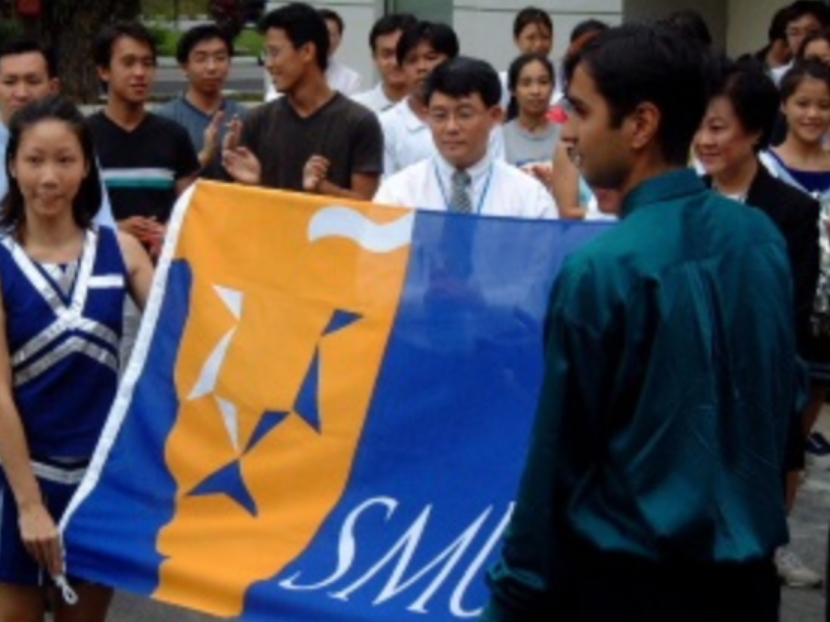
In 2018, the university rolled out school-specific flags. Each division bears its colour scheme while keeping the signature lion crest at the centre. Today, the SMU flag is more than an institutional symbol. It represents a shared vision of academic excellence and a deep connection to Singapore’s evolving identity.

A Historical Move
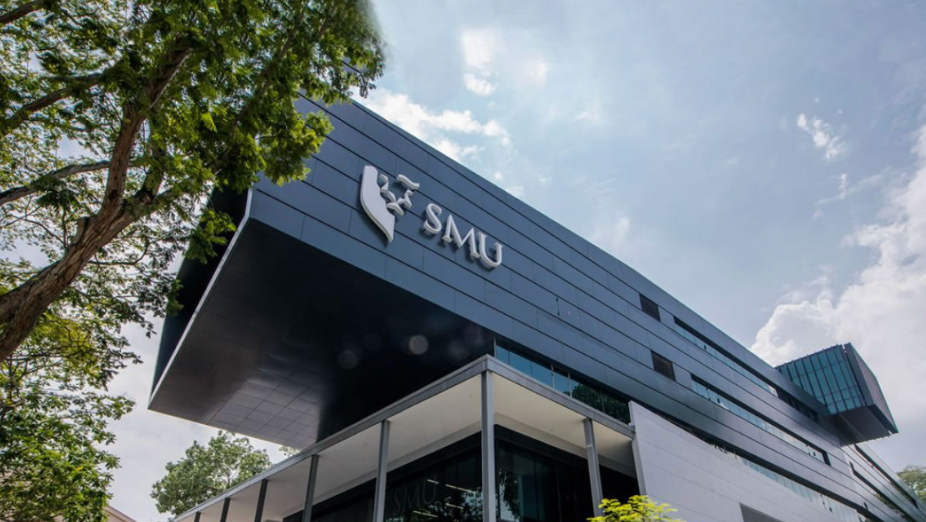
After establishing its academic schools and research centres in Bukit Timah, SMU made a landmark move in July 2005 into a purpose-built, 4.5-hectare city campus in the Bras Basah civic district. Designed to breathe with the city it inhabits, the campus integrates classrooms and cafes, placing its students right where life and learning collide. This pioneering city campus concept has become a model for urban universities worldwide, reflecting Singapore’s dual vision: to cultivate civic engagement and economic leadership.
SMU Today
In 2007, SMU unveiled its Yong Pung How School of Law; soon after, separate Schools of Economics and Social Sciences were formed. By 2011, the Lee Kong Chian School of Business had earned triple accreditation (AACSB, EQUIS, AMBA), which is a testament to SMU’s rapid ascent. Within a quarter-century, Singapore Management University has evolved from an audacious concept into a vibrant city. Today, as SMU stands at the crossroads of heritage and innovation, it reminds us that it is no longer just a prestigious institution, but rather a symbol of Singapore’s march towards entrepreneurship and a global economy.
Beyond the Campus
Furthermore, SMU is nestled in the heart of Singapore’s civic district. It enjoys more than just centrality, as the thriving environment of art, history, and creative expression forms more than just a subtle backdrop to academia. It is an extension of the classroom, acting as a rich source of inspiration which invites people to further reflect on what it means to be a thinking, feeling human in a hyper-modern city.
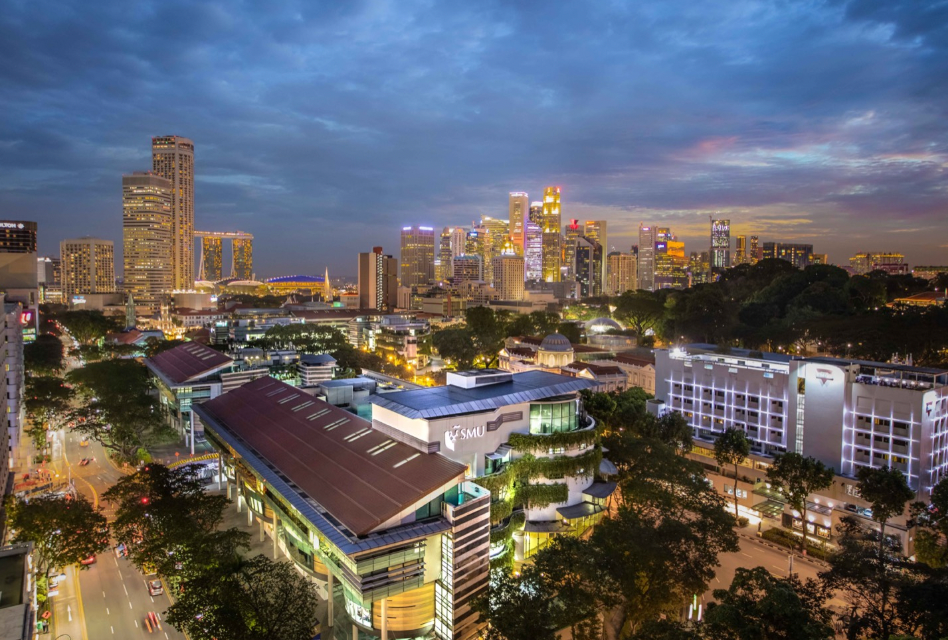
Inside Singapore’s Modernist Core
Just across the road from the SMU, tucked within the lobby level of the Carlton Hotel, Artcommune Gallery (#01-01) offers a direct portal into Singapore’s modern art scene. Founded in 2009 by artist-curator Ho Sou Ping, the gallery specialises in Singaporean modern art and represents an impressive roster of artists, including Cheong Soo Pieng, Chen Wen Tsi, Lim Tze Peng, and Ong Kim Seng. It is not just a space for visual appreciation, but also a trusted centre for art education, acquisition, and investment consultancy. Notable displays include Exotic Sunlight: Paintings by Ong Kim Seng (2016) and The Story of Cheong Soo Pieng (2015). For the curious eye, the gallery sits at the intersection between artistic heritage and contemporary insight, making it a cultural waypoint mere steps from campus.

A Wedge of Colour
Uphill from SMU, at the junction of Selegie Road and Prinsep Street, sits a strikingly narrow and wedge-shaped building. Its cheerfully painted window panes, assorted according to the colours of the rainbow, along with its unusual geometry, have earned it the status of a landmark. Selegie Arts Centre dates back to the late 19th century or early 20th century, when it was once part of a continuous row of shophouses along Prinsep Street. In 1994, the National Arts Council (NAC) repurposed the building from a bustling kopitiam to an arts centre under the Arts Housing Scheme. Since 1995, Selegie Arts Centre has been home to the Photographic Society of Singapore and the Loke Wan Tho Gallery, known for its display of mid-century monochrome works. In today’s fast-moving city, the Arts Centre offers a reflective space where heritage meets community.

Stacks, Staves, and Stories
Often affectionately dubbed “The City of Books”, Bras Basah Complex is a nostalgic and enduring centre for Singapore’s literary and creative communities. Since its establishment in the 1980s, it has been home to a colourful mix of independent bookstores such as Seng Yew Bookstore, Chinese calligraphy shops like Si Bao Zhai Arts Gallery, and music schools like Intune Music. In its early years, it hosted recitals of Singaporean songs, calligraphy competitions, and public book fairs, making it a key grassroots art venue. Over time, the complex has evolved into a quiet haven for artists, educators, and hobbyists. It continues to attract creatives from neighbouring institutions like the School of the Arts (SOTA), Nanyang Academy of Fine Arts (NAFA), and SMU.

Where Power Meets Performance
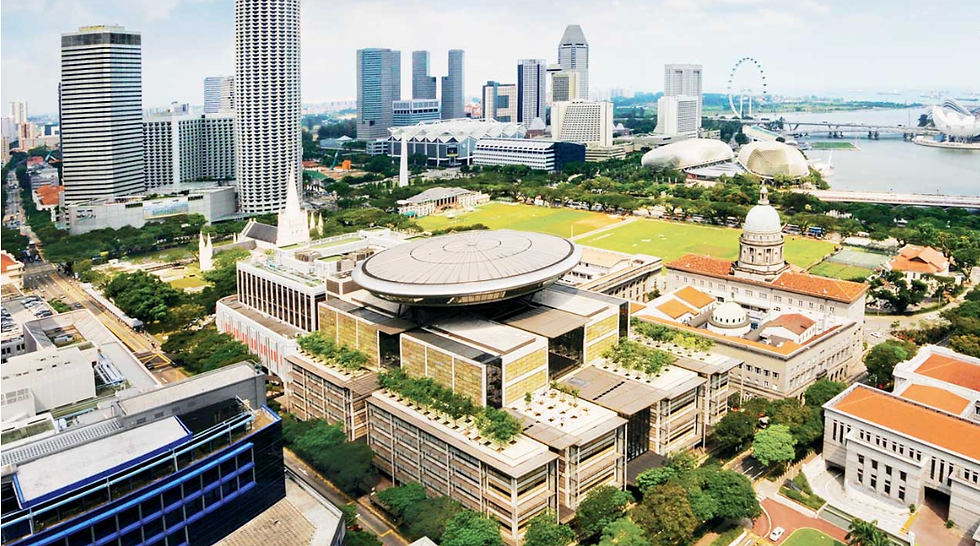
SMU sits on the doorstep of Singapore’s Civic District, where history intertwines with innovation in a modern landscape. Here, a cluster of national institutions forms the beating heart of the city’s artistic imagination.
A few blocks away stands the National Gallery Singapore, Southeast Asia’s premier institution for both modern and contemporary visual art. Housed in the restored former Supreme Court and City Hall buildings, the Gallery is home to the world’s largest public collection of modern art from Southeast Asia. It stages groundbreaking exhibitions like Siapa Nama Kamu? and Between Declarations and Dreams, exploring identity, nationalism, and Southeast Asia’s postcolonial experience. The National Gallery serves as more than a museum, offering its visitors a rich civic learning experience.
Further along the Singapore River, the Victoria Theatre and Concert Hall occupies a grand position among Singapore’s oldest cultural landmarks. First built in 1862 and restored in 2014, the complex features a mix of both colonial-era Palladian architecture and modern acoustics. It houses the Singapore Symphony Orchestra and regularly hosts everything from classical concerts to spoken word showcases. Historically, it was a site of early political rallies and the founding of the People’s Action Party, making it a venue where arts and politics have long converged. This makes it a prime location for deep reflection as delegates engage in their political debates over the 4 days at YMAX.
A Legacy in Motion
In many ways, SMU is more than just a university. It is a living dialogue between the past and the future, engaging in constant conversation with Singapore’s artistic and cultural heritage, with its prime position in the Civic District. From its early days on Evan Road to its current city campus, SMU has always stood for reinvention. Students learn not just from classrooms on campus, but also from the presence of museums, galleries, and bookshops that surround them. As YMAX 2025 unfolds in this vibrant landscape, delegates step into a campus that places them at the heart of the world.
Bibliography
Singapore Management University. “Our History.” Last modified 2024. https://www.smu.edu.sg/about/history.
National Library Board Singapore. “Singapore Management University.” Infopedia. Last modified August 16, 2023. https://www.nlb.gov.sg/main/article-detail?cmsuuid=010be2a1-37e2-42d5-9b1a-14b5c8fadb03.
Singapore Management University. “University Brand Identity.” Accessed June 13, 2025. https://www.smu.edu.sg/about/university-brand-identity.
Singapore Management University. “Campus Development.” Accessed June 13, 2025. https://www.smu.edu.sg/campus-life/campus-development.
Singapore Management University, School of Social Sciences. “About the School.” Accessed June 13, 2025. https://socsc.smu.edu.sg/about/about-school.
Singapore Management University, SMU Masters. “About Us.” Accessed June 13, 2025. https://masters.smu.edu.sg/about-us.
Artcommune Gallery. “About.” Accessed June 13, 2025. https://www.artcommune.com.sg/about.
Remember Singapore. “Selegie Arts Centre Building.” Remember Singapore. January 20, 2021. https://remembersingapore.org/2021/01/20/selegie-arts-centre-building/.
Housing & Development Board. “Bras Basah Complex.” Accessed June 13, 2025. https://www.hdb.gov.sg/residential/where2shop/explore/central-area/bras-basah-complex.
Bras Basah Complex. “About Us.” Accessed June 13, 2025. https://bras-basah-complex.com.sg/about-us/.
National Gallery Singapore. “Architecture and History.” Accessed June 13, 2025. https://www.nationalgallery.sg/sg/en/architecture-and-history.html.
Roots.sg. “Victoria Theatre and Concert Hall.” National Heritage Board. Accessed June 13, 2025. https://www.roots.gov.sg/places/places-landing/Places/national-monuments/victoria-theatre-and-concert-hall.

Comments