
ASEAN’s child labour industry: A promising look for the future, with need for consideration
- Phnom Penh Post

- Jun 17, 2025
- 3 min read
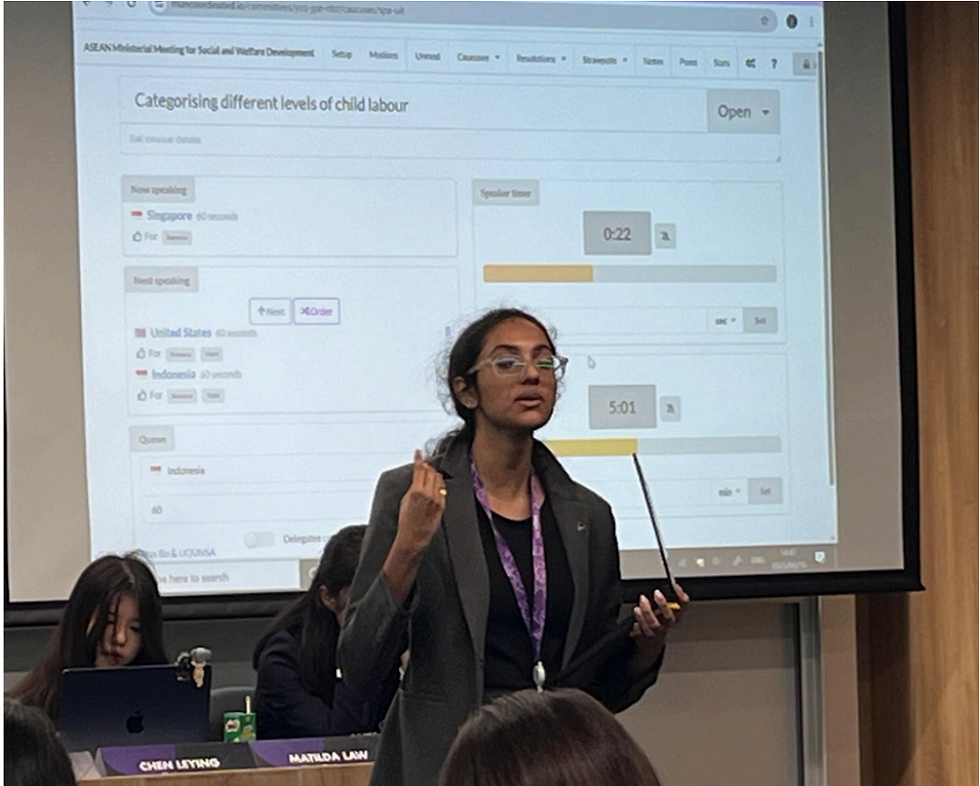
In the first ASEAN Ministerial Meeting on Social and Welfare Development (AMMSWD), delegates approved the proposal of mitigating the entrenchment of child labour in ASEAN through vocational training and part-time education.
Shortly after Committee was in session, the Minister of Singapore presented ideas through an Alternative Learning Track (ALT) Framework, which involved integrating child labourers back into society through employment in jobs that offered better working conditions. While children do still engage in labour, the Minister of Singapore argues that this is an imperative first step towards the eradication of child labour.
The Minister of China mentioned that “to fight child labour effectively, understand not all work done by children is the same.”
Currently, child labour remains a prominent issue in ASEAN countries, largely owing to its root cause of impoverishment amongst many families in the region. Vocational training offers to change that: by providing children with better working facilities and conditions, compared to the likes of sweatshops, for example, children develop more skills relevant to
society and hence gain the opportunity to climb the social ladder.
That being said, ASEAN has already taken similar action in the past. In 2019, 30,000 Cambodian children were reportedly rescued from serious forms of labour, with 180,000 being rescued from child labour through access to education and skill development. Even though child labour remains a budding issue in ASEAN states, significant progress has already been made.
Additionally, in support of the proposed solutions, the ministers of Laos and Vietnam proposed different frameworks– COOK and PHO (Protection, Hours, Objection) — to endorse and consolidate the given ideas through organisation and what they wish to implement. The first classifies levels of visibility of varying child labour sectors, with
domestic sectors being the most “invisible” and difficult at the third tier, and labour such as agriculture and mining being more dangerous and relatively discoverable. The second underscores the importance of child protection rights and advocating for better labouring conditions.
Following this, the ASEAN ministers reinforced and ratified ILO Conventions 138 and 182, enforcing labour laws regarding the minimum age for child labour, and eliminating the worst forms of child labour. However, member states, while largely in agreement, have raised concerns regarding the vagueness surrounding what defines child domestic labour and what breaches their laws.
For example, Cambodia has expressed concerns regarding what falls under the category of child domestic labour. As ASEAN countries with less economically developed populations often fall short in education due to the lack of financial means, it is harder to climb the social ladder, and hence, child labour becomes a driving force for both the family on an individual level and the economy of the nation on a country-wide scale. To penalise countries struggling with conditions beyond their control would be detrimental to the social and economic stability of ASEAN as a whole.
In order to alleviate such measures, Singapore has introduced part-time education as a measure to provide an opportunity for families to escape the cycle of poverty, thus addressing the root cause of child labour. However, this is a long-term measure that may not yield visible results in
ASEAN countries struggling with child labour, so civilians will have to remain patient and trust in change, which may be difficult for victims of child labour who actively deal with the problems discussed.
Cambodia strongly supports the efforts to draw the boundaries of the definition of child labour. During the unmoderated caucus, Cambodia raised issues regarding the funding of solutions to help with poverty reduction. The Committee concluded that they can be funded through active NGOs and UN neutral sub-organisations, painting a rather bright future for ASEAN’s goals for eliminating child labour.
In general, a consensus was reached among ASEAN member states. While countries, for example, Australia, disagreed with the focus of the argument, the Committee has agreed on steps taken that can help with solving the issue of child labour, with explicit frameworks that indicate the interest of nations to resolve the issue in solidarity. By defining and solving the issue through the ACT framework (Accountability, Collaboration, Transparency), ASEAN is one step closer to eradicating child labour.
However, some pertinent issues need addressing: for example, the economical recovery of countries reliant on child labour after such policies are imposed, have yet to be discussed. Countries should give more consideration towards the negative effects of policies that they
have imposed, as well as render help to those impacted countries. Like what the Minister for Indonesia mentioned, “if they need support in expertise, the country will have it (through ASEAN).”
By Lecus Koh Luck Khye, Tan Wee Kiat Nicolas and Ryan Ong Wei Heng


Comments